
About
He learned the trades first, then went back for the engineering
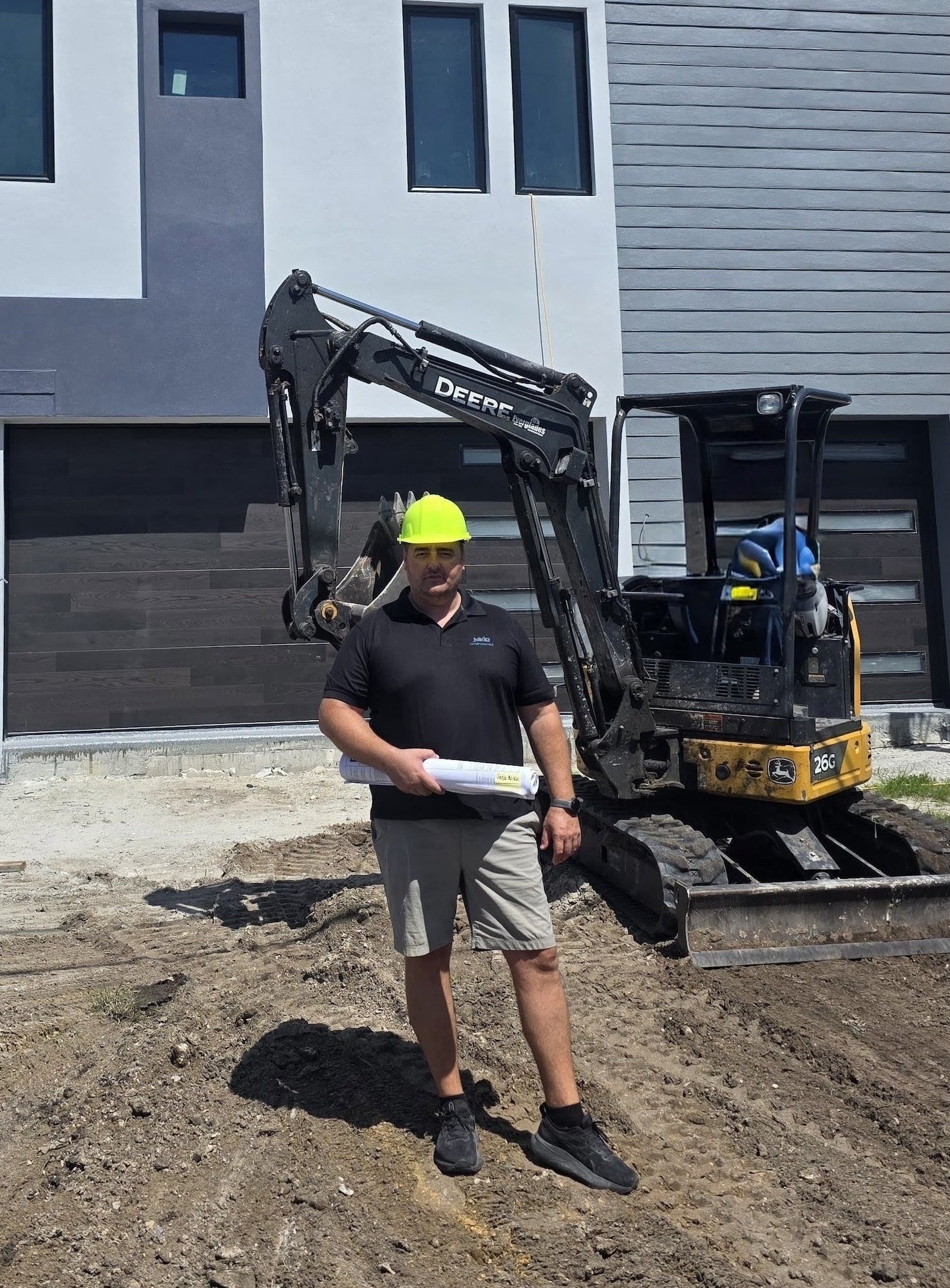
Sasa Nikic holds a civil engineering degree with a structural focus and a Florida general contractor’s license, CGC1526252. He also spent 12 years with tools in his hands before either of those existed. Both halves matter, and the second one is harder to find.
The short version
2002 — Setting tile
Helper on spec houses. Partner in the tile business within about a year.
2005 — Buying and rebuilding houses
Framing, concrete, drywall, cabinetry. Four trades hired out; the rest done himself.
2009 — Back to school
St. Petersburg College, then USF. Civil engineering with a structural focus, while still contracting.
2015 — DOT bridge reconstruction
Superintendent and project manager across six states. Three years of infrastructure tolerances.
2018 — Nikic Construction
Licensed as a Florida general contractor, building on the Pinellas beaches.
Starting with tile
In 2002 Sasa was setting tile as a helper on spec houses — Lennar, Premier, Mercedes, Pulte, KB Homes. Within about a year he was a partner in the tile business rather than working for it. Tile turned into hardwood, hardwood into pavers.
By 2005 he and a partner had moved into buying distressed houses and rebuilding them to sell. On those projects they did nearly everything themselves: demolition, framing, drywall, concrete and block work, small plumbing repairs, pavers, cabinetry. They hired out four trades entirely — electrical, air conditioning, roofing, and larger plumbing work — and did the rest.
That’s a specific kind of education. When you have personally hung the drywall, you know what the framer should have done differently. When you have poured the slab, you know which shortcuts show up two years later. Sasa still works with that partner today; he’s one of the subcontractors on Nikic projects.
School, without leaving the site
In spring 2009 Sasa enrolled at St. Petersburg College for an associate degree, then transferred to USF in Tampa. He finished with a Bachelor of Science in Civil Engineering, concentrating in structures.
He did not stop working while he did it. Through those years he was running his own contracting business — tile and remodeling — and taking classes around it. The engineering wasn’t a career change away from construction. It was an attempt to understand, from the calculation side, the things he had already been building with his hands.
Three years of bridges
From early 2015 to April 2018, Sasa was a superintendent and project manager on Department of Transportation infrastructure work — bridge reconstruction across Florida, Georgia, the Carolinas, Texas, and Connecticut.
Bridge work has a different tolerance for error than residential construction. Column replacement on a live structure uses #8 and #9 rebar, inspection is continuous, and the consequences of getting a load path wrong are not a warranty claim. Three years of that changes how you read a set of drawings.
It also meant constant travel. By 2018, with an investor opportunity in hand and a family he wanted to be home with, Sasa took the general contractor’s license he had already earned and started Nikic Construction.
What the combination does
Most builders have one side or the other. Plenty of general contractors came up through the trades and know a wall is wrong by looking at it, without being able to say why in numbers. Plenty of engineers can run the numbers and have never watched a crew try to build what they specified.
The combination is what lets Sasa read a set of structural drawings the way the field will actually execute them — and catch the places where those two things diverge.
On a Belleair Beach house, a wall was removed during design to open up the floor plan — but the beam above it was never resized for the longer span it would now have to carry alone. Sasa caught it before anything was poured and gave the engineer two options: reinforce the beam, or put the wall back. They restored the wall, keeping the beam exactly as it had originally been designed. Nobody on that job was going to catch it from the drawings alone, and nobody was going to catch it in the field either — it needed someone reading both at once.
The same habit shows up differently on a Lutz project, on ground nobody had tested first. A soil test nobody required — Sasa’s own suggestion, not a contractual one — found the ground too soft for the original design. Left as drawn, engineers calculated 3 to 4 inches of settlement: cracked walls, damage over time. The foundation was redesigned before anything was poured.
How the work runs
The combination shows up in how the work runs. Subcontractors are vetted before they’re hired — licensing, insurance, previous work, checked by Sasa rather than taken on price. Every project includes a framing walkthrough before drywall closes the walls, where the client walks the house and changes what they want changed. Sasa inspects every house himself before handover. And Nikic won’t build with client-arranged international material orders, because when something arrives damaged or late from six thousand miles away, the schedule and the responsibility land in the wrong place.
None of it is complicated. It’s the standard Sasa’s parents taught him: do it once and do it right.
“We walk with them to the house and say: okay, is this the layout that you want? Do you want us to change something? It’s time now.”
Where we work
Custom homes across the Pinellas County beaches, South Tampa, and Davis Islands — the primary focus, with other Tampa Bay area locations considered — along with pools and a growing amount of commercial work.
Sasa Nikic — BS Civil Engineering, structural concentration, USF · Florida Certified General Contractor CGC1526252